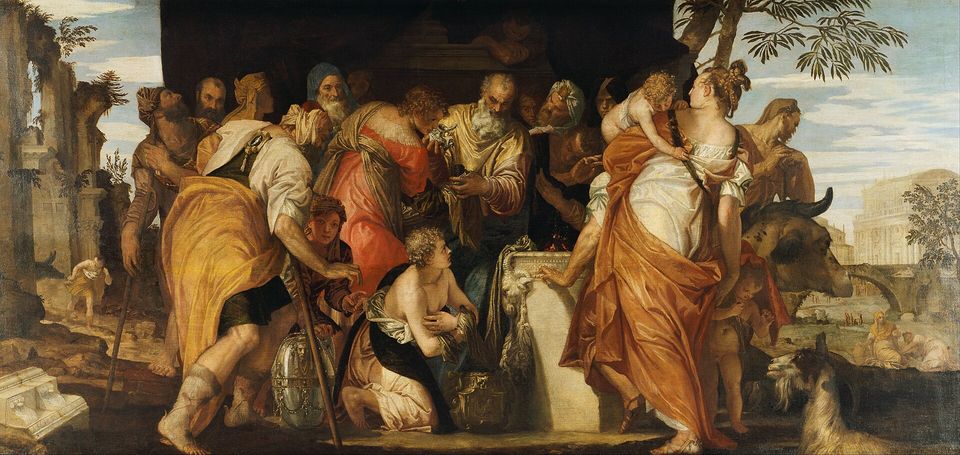
Our Pastor did a creative first-person sermon on King David’s older brother Eliab in church today.
Everybody knows David. Most people can tell you about the sling, the five stones, and the giant who fell on his face.
Almost nobody remembers his oldest brother.
His name was Eliab. He shows up in only a handful of verses, but they’re some of the most honest verses in the Bible about what happens inside a man who gets passed over. If you’ve ever watched someone younger, smaller, or less experienced get the thing you thought was yours, Eliab is worth your time.
He looked the part
God sent Samuel to Bethlehem to anoint the next king from among Jesse’s sons. Jesse lined them up, oldest first. Eliab walked in, and Samuel was sold.
“When they came, he looked on Eliab and thought, ‘Surely the LORD’s anointed is before him’” (1 Samuel 16:6).
You can see why. Eliab was the firstborn. He was tall. He looked like a king. He looked, in fact, a lot like Saul, the king Israel already had, who stood head and shoulders above everyone else (1 Samuel 9:2).
And God said no.
“Do not look on his appearance or on the height of his stature, because I have rejected him. For the LORD sees not as man sees: man looks on the outward appearance, but the LORD looks on the heart” (1 Samuel 16:7).
Lesson one: you can look the part and not have the heart. Size, seniority, polish, and presence get noticed. They get men hired, elected, and put up front. They don’t impress God. He already tried a tall king. It didn’t go well.
That’s a word for churches choosing leaders, and it’s a word for any man who’s been leaning on his résumé. God isn’t grading the outside.
He watched it happen
One by one, all seven sons in the room were passed over. Then Jesse admitted there was one more, the youngest, out with the sheep. They sent for him. And “Samuel took the horn of oil and anointed him in the midst of his brothers” (1 Samuel 16:13).
In the midst of his brothers. Eliab had a front-row seat.
The text doesn’t tell us what he felt. It doesn’t have to. A few chapters later we find out what he did with it.
Lesson two: being passed over doesn’t create what’s in your heart. It reveals it. Disappointment is a diagnostic. When someone else gets the role, the recognition, or the blessing, whatever comes out of you was already in there. That’s painful to see. It’s also a gift, because you can’t repent of what you won’t look at.
He was angry at the wrong person
Fast forward. Eliab and the next two brothers are soldiers in Saul’s army, camped across the valley from the Philistines (1 Samuel 17:13). Every morning and every evening for forty days, Goliath comes out and dares Israel to send a man. Every day, nobody goes. “All the men of Israel, when they saw the man, fled from him and were much afraid” (1 Samuel 17:24).
Then little brother shows up with lunch. He hears the giant, and he starts asking questions out loud: Who is this man, that he should defy the armies of the living God?
Here’s how Eliab responds:
“Now Eliab his eldest brother heard when he spoke to the men. And Eliab’s anger was kindled against David, and he said, ‘Why have you come down? And with whom have you left those few sheep in the wilderness? I know your presumption and the evil of your heart, for you have come down to see the battle.’” (1 Samuel 17:28)
Read that again slowly. There’s a nine-foot enemy on the other side of the valley mocking God, and the only person Eliab gets angry at is his brother.
Lesson three: anger at someone else’s courage is often cover for our own fear. Eliab had been standing in that camp for forty days doing nothing. David’s faith didn’t threaten the Philistines yet. It threatened Eliab, because it exposed him. It’s always easier to attack the man who’s willing to go than to admit you’ve been afraid to.
I’ve seen this in churches. Someone new has a fresh idea, a little holy boldness, a willingness to try what the rest of us have talked about for years. And the sharpest pushback doesn’t come from the world. It comes from the brothers who’ve been in the camp the longest.
He belittled small, faithful work
Notice the dig: “those few sheep.”
Eliab wanted David to feel small. He wasn’t a soldier. He was a shepherd boy with a little flock, and he should get back to it.
But those few sheep were exactly where God had been training him. A few verses later David tells Saul how he’d killed a lion and a bear to protect that flock, and how “the LORD who delivered me from the paw of the lion and from the paw of the bear will deliver me from the hand of this Philistine” (1 Samuel 17:37).
Lesson four: don’t despise the few sheep. Not yours, and not somebody else’s. Small, unseen faithfulness is where God builds men. Some of the most important work in the kingdom happens in places nobody bothers to visit. If you’re the one keeping a few sheep right now, keep them well. If you’re tempted to sneer at someone else’s few sheep, be careful. God might be training a giant-killer in that field.
He claimed to know a heart he couldn’t see
Here’s the irony that stops me every time.
“I know your presumption and the evil of your heart,” Eliab says.
The heart. That’s the very thing God had looked at in Bethlehem. God looked at Eliab’s heart and said no. God looked at David’s heart and said yes. And now Eliab stands in the camp, absolutely confident that he can read his brother’s motives.
Lesson five: be slow to diagnose another man’s heart, especially when you’re jealous of him. Envy makes us terrible judges. It takes someone’s faith and calls it pride. It takes their courage and calls it showing off. Most of the time, when I’m sure I know exactly what’s wrong with someone’s motives, I’m describing my own.
Jesus put it plainly: “first take the log out of your own eye, and then you will see clearly to take the speck out of your brother’s eye” (Matthew 7:5).
How David handled it
David’s answer is short. “What have I done now? Is it not but a word?” And then, “he turned away from him toward another, and spoke in the same way” (1 Samuel 17:29-30).
He didn’t defend himself for an hour. He didn’t stay and win the argument. He didn’t let his brother’s contempt pull him off mission. He turned away and kept asking about the real enemy.
Lesson six, for the man on the receiving end: don’t let a brother’s bitterness become your battle. Some criticism deserves a long, humble listen. Some is just an Eliab having a bad day in front of his fear. You can answer briefly, refuse to fight, and keep your eyes on the giant.
Is that the end of his story?
We don’t get much more about Eliab, and I don’t want to say more than the Bible does. But there are hints that his story didn’t end in that camp.
When David was on the run from Saul and hiding in the cave of Adullam, “his brothers and all his father’s house heard it, they went down there to him” (1 Samuel 22:1). The brothers who once looked down on him came to him when he was hunted.
Later, the leader over the tribe of Judah is named as “Elihu, one of David’s brothers” (1 Chronicles 27:18). Many scholars think that’s Eliab under another form of his name; the ancient Greek translation reads “Eliab” there. And Eliab’s daughter Abihail married one of David’s sons, so her daughter became the wife of King Rehoboam (2 Chronicles 11:18).
If that’s right, the oldest brother who was passed over eventually took his place under the younger brother God chose. That’s not humiliation. That’s grace.
The Brother who wasn’t passed over
Eliab sounds a lot like another older brother: the one in Jesus’ parable who stood outside the party, angry that his younger brother got the robe, the ring, and the fattened calf (Luke 15:28). Same resentment. Same sense of being owed. (I wrote more about that heart in Two Resentments, One Root.)
Most of us have an Eliab in us. We want the oil poured on our head. We’d rather criticize the man who goes than go ourselves.
The good news is that there’s a better Firstborn. Jesus is “the firstborn among many brothers” (Romans 8:29), and He didn’t cling to His place. He gave it up. He was the one rejected, “despised and rejected by men” (Isaiah 53:3), so that people like Eliab, and people like me, could be welcomed in.
He doesn’t ask you to pretend you weren’t disappointed. He asks you to bring it to Him before it hardens into contempt.
A few questions to sit with
- Whose blessing, promotion, or success has been hardest for me to celebrate lately? What does that reveal?
- Where am I standing in the camp, afraid, and criticizing someone who’s willing to go?
- Whose “few sheep” have I looked down on?
- Is there an Eliab in my life I need to answer briefly and then turn away from, without bitterness?
- Is there a brother I need to go down to, the way Jesse’s sons went down to Adullam?
See also
Enjoyed this article?