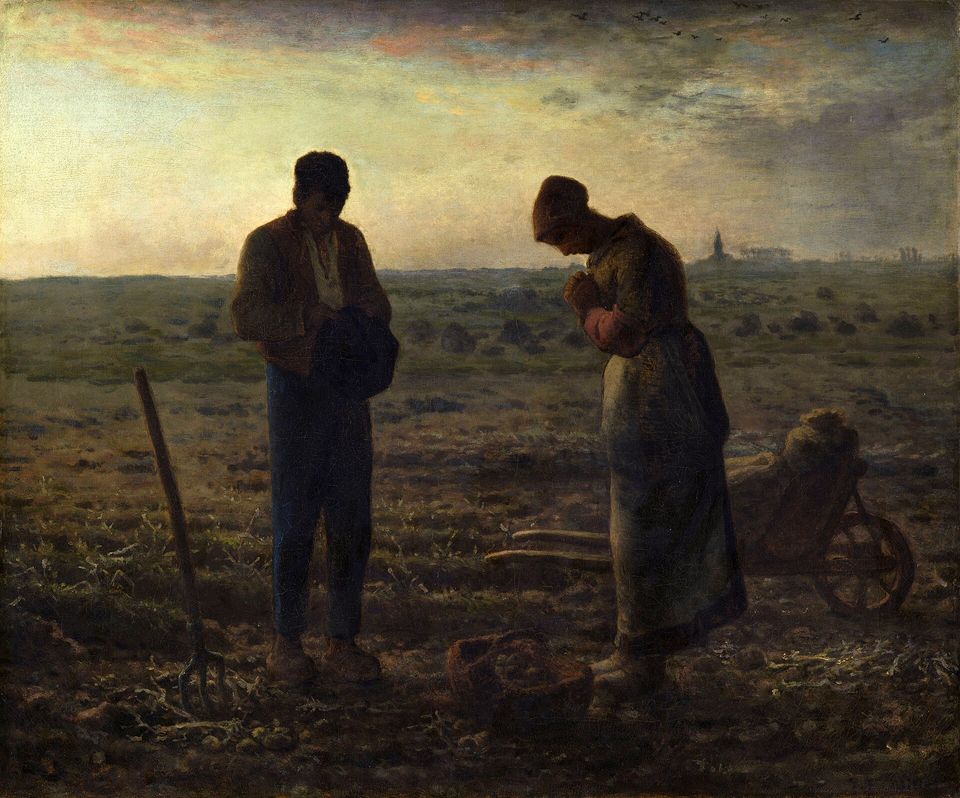
Somewhere this morning a man is sorting mail. Nobody is filming it. Nobody will pray over him on Sunday or put his picture on a missions board. He clocks in, works hard, clocks out, and goes home.
I want to say something to that man: the faithfulness God is looking for may be happening right there at the sorting table.
In my last article, I prayed that our action would flow from unction, that what we do would come out of what the Holy Spirit has first done in us. This is the other half of that prayer. If faithfulness means following the Spirit’s leading, then it can happen anywhere the Spirit is. And the Spirit is everywhere.
The myth of the higher calling
Without ever saying it out loud, the church often ranks callings. At the top are missionaries and pastors. Somewhere below them are worship leaders and church staff. Then, far below, come the rest of us, the plumbers and nurses and accountants and postal workers. Their job is to keep the church running and fund the people doing the “real” ministry.
It sounds humble. It isn’t biblical.
The Dutch theologian and prime minister Abraham Kuyper put it this way: “There is not a square inch in the whole domain of our human existence over which Christ, who is Sovereign over all, does not cry: Mine!” The post office is one of those square inches. So is the loading dock, the cubicle, the cab of the truck, and the kitchen table at 6 a.m.
And you didn’t land there by accident. Paul told the Athenians that God determined “the boundaries of their dwelling place” (Acts 17:26). To the Corinthians, many of whom had ordinary jobs and some of whom were slaves, he wrote, “Only let each person lead the life that the Lord has assigned to him, and to which God has called him” (1 Corinthians 7:17). Your route, your shift and your coworkers are part of an assignment.
Never forget that the Son of God spent most of His earthly life in a workshop. For roughly thirty years, Jesus was known in Nazareth as “the carpenter” (Mark 6:3). Those years were not wasted. They were not a waiting room before the real ministry. The Father was pleased with His Son before He had preached a single sermon (Matthew 3:17).
Faithfulness is following, not looking spiritual
Here is the heart of it. Faithfulness is not doing the thing that looks the most spiritual. Faithfulness is following the unction of the Holy Spirit, wherever and whenever you are.
That means a man who boards a plane for the mission field without the Lord sending him is actually less faithful than the postal worker who speaks one sentence to a coworker because the Spirit prompted him. The first looks more impressive. The second is more obedient. Samuel told King Saul, “To obey is better than sacrifice” (1 Samuel 15:22). Saul’s problem wasn’t a lack of religious activity. It was religious activity God hadn’t asked for.
One of my favorite stories in the Gospels makes the point. Jesus set a man free from a legion of demons. Overflowing with gratitude, the man begged to get in the boat and go with Jesus. Who wouldn’t want that? It was the most spiritual-looking option available. But Jesus said no: “Go home to your friends and tell them how much the Lord has done for you” (Mark 5:19). His calling wasn’t the boat. It was home.
Even the apostle Paul, the great missionary, didn’t go everywhere that seemed strategic. Acts 16 says he and his companions were “forbidden by the Holy Spirit to speak the word in Asia,” and when they tried to go into Bithynia, “the Spirit of Jesus did not allow them” (Acts 16:6–7). Paul’s faithfulness was measured by following, not by mileage.
Go, speak, stay, be still
The Spirit’s leading is rarely dramatic. Most of the time it looks like one of four simple words.
- Go. The Spirit told Philip, “Go over and join this chariot” (Acts 8:29). For you, it might be walking over to the guy eating alone in the break room.
- Speak. It might be one honest sentence to a coworker whose marriage is falling apart: “I’ll be praying for you. Can I pray with you right now?”
- Stay. It might be staying at the job you’d love to leave, because God isn’t finished with you there, or with the people around you.
- Be still. Ecclesiastes says there is “a time to keep silence, and a time to speak” (Ecclesiastes 3:7). Sometimes faithfulness is keeping your mouth shut when everyone is complaining about the supervisor.
None of those require a title, a stage or a budget. They require a man who is awake to God, listening through the day the way you’d listen for your name in a crowded room.
The quiet life is not a lesser life
Paul gave the Thessalonians an ambition that sounds almost strange today: “Aspire to live quietly, and to mind your own affairs, and to work with your hands” (1 Thessalonians 4:11). He wasn’t settling for second best. He was describing a life that will “walk properly before outsiders” (4:12) and quietly show them what Jesus is like.
And to workers who had every reason to feel unseen, he wrote, “Whatever you do, work heartily, as for the Lord and not for men… You are serving the Lord Christ” (Colossians 3:23–24). You aren’t serving the Postmaster General. You’re serving the King, and He sees every letter you sort.
It gets no notice here. That’s all right. Jesus said your Father “who sees in secret will reward you” (Matthew 6:4).
A word to the common man
If you’re the guy with the normal job that nobody notices, hear me: you are not on the bench. You’re not waiting for your “real” calling to start. You are already in the field, already assigned, already sent.
So tomorrow morning, before you clock in, pray something simple: Lord, I’m Yours here. When You say go, I’ll go. When You say speak, I’ll speak. When You say stay, I’ll stay. When You say be still, I’ll be still.
Then go do your job well, and keep listening.
That’s not a lesser spirituality. That’s everyday spirituality for the common man. And I’m convinced it’s the kind of faithfulness every man is called to embrace.
See also
- Sphere Sovereignty by Abraham KuyperInaugural address at the Free University of Amsterdam, 1880, the source of the "every square inch" quotation.
Enjoyed this article?