Faithful and empty
You’re doing everything right. You read your Bible before school or work. You pray. You show up on Sunday, maybe Wednesday too. You haven’t missed a day of your reading plan in months.
And you feel nothing.
The words on the page are just words. Your prayers bounce off the ceiling. Worship feels like singing along to the radio. Nobody would guess anything is wrong, because from the outside nothing is. That’s part of what makes it so lonely.
If that’s you, I want you to hear two things before anything else. First, you are not a fake. Second, this place you’re in has a name, and God has met people here for thousands of years. The way through it isn’t to try harder at the routine. It’s something older and stranger: holy desperation.
What holy desperation is
Holy desperation is what happens when you stop treating God as part of your routine and start treating him as your only hope. It’s the prayer of someone who has run out of their own resources and knows it.
It is not despair. Despair says, “Nothing will change, so why ask?” Holy desperation says, “Nothing will change unless you do something, so I won’t stop asking.” Despair turns away from God. Desperation grabs hold of him.
Here’s the hard truth about habits. They are good, and they are necessary, but they can quietly become a way to manage God. If I do my fifteen minutes, I’ve done my part. The habit becomes the goal instead of the doorway. When the feelings dry up, that’s often God’s mercy: he’s letting you discover that the routine was never the point. He is.
The Bible is full of desperate people
If you think real Christians always feel close to God, read the Psalms. A huge share of them are written from the dry place. God put those prayers in his book on purpose, so you’d have words when you have none.
David in the desert (Psalm 63:1). “My soul thirsts for you… in a dry and weary land where there is no water.” David isn’t describing a feeling of closeness. He’s describing thirst. Thirst is what you feel when you don’t have water. Notice he still says “my God.” The dryness didn’t cancel the relationship.
The downcast soul (Psalms 42 and 43). The psalmist preaches to himself: “Why are you cast down, O my soul?” Three times he answers the same way: hope in God, “for I shall again praise him.” Not now. Again. He tells his feelings what’s true and waits for them to catch up.
How long? (Psalm 13). Four times in two verses David asks God “how long?” That’s not a polite prayer. But the psalm ends with “I have trusted in your steadfast love.” Honesty and trust live in the same prayer.
Jacob at the river (Genesis 32:26). Jacob wrestles all night and refuses to let go: “I will not let you go unless you bless me.” He walks away limping and blessed. Sometimes desperation looks like simply refusing to quit holding on.
The father at the foot of the mountain (Mark 9:24). “I believe; help my unbelief!” This may be the most honest prayer in the Bible. Jesus doesn’t scold him for the mixed faith. He heals his son.
Blind Bartimaeus (Mark 10:46–52). The crowd tells him to be quiet. He yells louder: “Son of David, have mercy on me!” Desperate people don’t care how it looks.
Jehoshaphat facing an army (2 Chronicles 20:12). “We do not know what to do, but our eyes are on you.” You don’t need a plan to pray. You just need to know where to look.
More to pray when you’re dry
- Psalm 77 — “Has God forgotten to be gracious?” then turning to remember what God has done.
- Psalm 88 — the one psalm that ends in darkness. It’s in the Bible to tell you that even an unresolved prayer is still a prayer.
- Psalm 130 — “Out of the depths I cry to you,” and waiting for the Lord “more than watchmen for the morning.”
- Habakkuk 3:17–18 — no figs, no fruit, no flock, “yet I will rejoice in the Lord.”
- Lamentations 3:19–24 — remembering affliction, then “his mercies… are new every morning.”
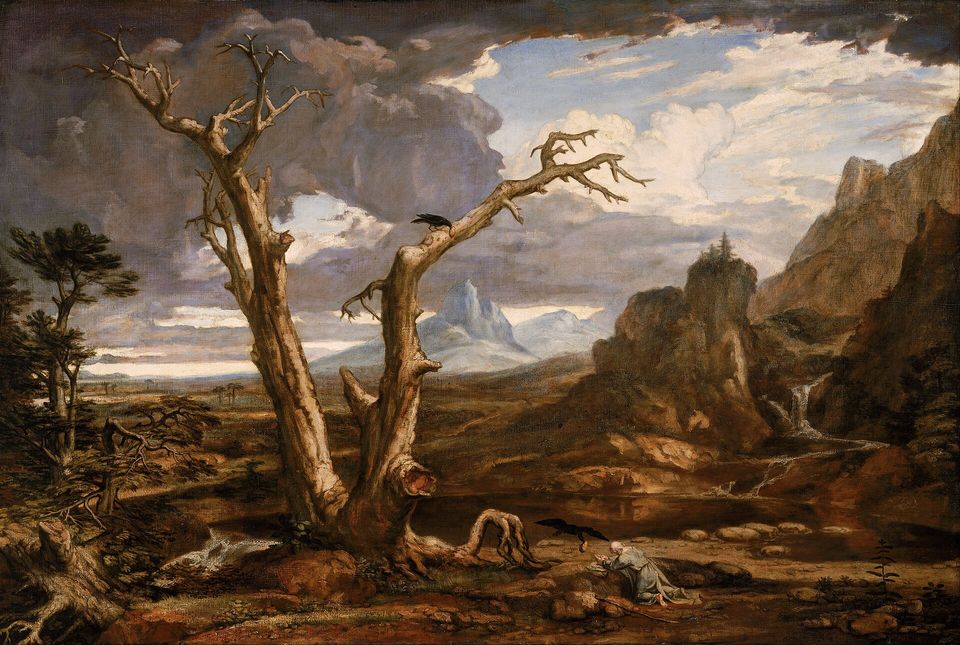
- 1 Kings 19 — Elijah, burned out under a broom tree, gets food and sleep before he gets a word from God.
- Matthew 14:30 — Peter sinking: “Lord, save me.” Three words is enough.
- Luke 18:1–8 — the persistent widow, told so that we “ought always to pray and not lose heart.”
- Matthew 26:36–46 — Jesus in Gethsemane, “very sorrowful, even to death,” praying the same prayer three times.
What the desert fathers knew
In the 300s, thousands of Christians moved into the Egyptian desert to give their whole lives to prayer. You’d think if anyone felt close to God, it would be them. Instead, they wrote some of the most honest words we have about spiritual dryness. They had a name for it.
Acedia: the noonday demon. Evagrius of Pontus called it acedia, a heavy listlessness that hit monks in the middle of the day (he connected it to the “destruction that wastes at noonday” in Psalm 91:6). He described a monk staring at the window, checking the sun, wishing the day would end, sure that he’d be more spiritual somewhere else. Sound familiar? It’s the same feeling as scrolling your phone during your quiet time. Evagrius’s advice was simple: don’t run. Stay put, keep working, and when the thoughts come, answer them with Scripture.
“Your cell will teach you everything.” A young monk came to Abba Moses asking for a word. Moses told him to go and sit in his cell, and the cell would teach him everything. In other words: the answer isn’t a new technique or a better spiritual high. It’s staying in the place God put you, with him, even when it’s boring.
Antony and the rope. Antony, the most famous of them all, once sat in the desert overwhelmed by gloom and distracting thoughts. He asked God how he could be saved when his own mind wouldn’t let him. Then he saw someone like himself sitting and weaving rope, then standing to pray, then sitting to weave again. He heard: do this and you will be saved. Faithfulness in the dry season is often just that. Work, pray, work, pray. Don’t wait to feel it.
Syncletica and the smoke. Amma Syncletica, one of the desert mothers, said that coming near to God starts with struggle and only later brings joy. She compared it to lighting a fire. At first you’re choked by smoke and your eyes water, but that’s how you get the fire. The tears aren’t a sign you’re doing it wrong. They’re a sign the fire is catching.
“Why not become fire?” This is my favorite. Abba Lot came to Abba Joseph and said, more or less: I keep my little rule of prayer. I fast a little. I pray and meditate. I try to keep my thoughts clean. What else can I do? Joseph stood up, stretched his hands toward heaven, and his fingers became like ten lamps of fire. He said, “If you will, you can become all flame.”
Lot is you. Faithful in his habits. Doing all the right things. And sensing that there has to be more. Joseph didn’t tell him to drop the habits. He told him the habits were the fireplace, not the fire.
Of course, it isn’t quite as simple as Abba Joseph makes it out to be here. It’s not just a matter of wanting to be filled with the divine light and it ‘magically’ happens. What I think he’s getting at in his response to Abba Lot is that, at the end of the day, it’s not about what specifically we are doing. It’s not about ticking off boxes in a spiritual to-do list. It’s about turning over the will entirely to God, becoming single-minded about becoming ‘all flame’.
Light us up, Lord, light us up!
What to do when the routine goes rote
- Keep the habits. Don’t quit reading or praying because it feels empty. The desert fathers’ first rule was “stay in your cell.” Feelings follow faithfulness far more often than faithfulness follows feelings.
- Tell God the truth. Stop praying the polished prayer. Say, “I feel nothing right now, and I hate it.” That’s what the Psalms do. God can handle your honesty. He can’t do much with pretending.
- Borrow someone else’s words. When you have nothing, pray a psalm out loud. Psalm 63 or 42 is a good start. You’re not faking it. You’re letting Scripture pray for you until your heart catches up.
- Ask for more. Holy desperation asks God for himself, not just for a better mood. “I don’t want a good quiet time. I want you.” Jacob wouldn’t let go until he was blessed. Be stubborn like that.
- Break the pattern on purpose. Read a whole book of the Bible in one sitting instead of a chapter. Pray on a walk instead of in your room. Fast a meal and pray when you’re hungry. A small change can wake up what the routine put to sleep.
- Talk back to the lies. When you think, “I’m a fake,” or “God has left me,” answer it with Scripture the way Evagrius taught: “Hope in God, for I shall again praise him.”
- Don’t go it alone. Tell one trusted person: a parent, a pastor, a youth leader, a friend who prays. The desert monks went to an older abba for a word. You need one too.
- Check the basics. Elijah’s first step out of the wilderness was a nap and a meal. Sometimes spiritual numbness is tangled up with too little sleep, too much screen, or real sadness that deserves real help. If the heaviness doesn’t lift, talk to someone who can help you sort it out.
The fire is still yours
The dry season is not proof that God left. Often it’s proof that he’s drawing you past the habit to himself. The same God who met David in the desert, Jacob at the river, and Elijah under the tree is not done with you.
So keep showing up. Keep the fireplace clean. And pray like someone who needs God, because you do: “I believe; help my unbelief.”
You can become all flame.
See also
- The Sayings of the Desert Fathers by Benedicta Ward, trans., Cistercian PublicationsSource of the sayings of Abba Moses, Antony, Amma Syncletica, and Abba Joseph and Abba Lot, paraphrased here.
- The Praktikos by Evagrius PonticusEvagrius's description of acedia, the noonday demon (chapter 12).
Enjoyed this article?