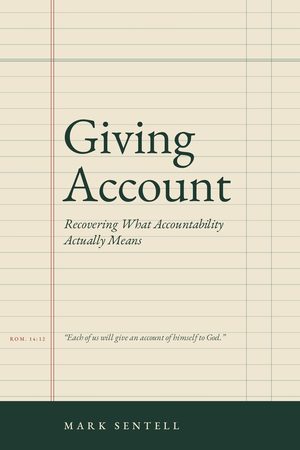
Giving Account
Recovering What Accountability Actually Means
Mark Sentell
This book shouldn’t take very long to read, but I know you’re busy, so if you can only read two pages, these are them.
Accountability is something you give, not something done to you. An account is a report. In Scripture, the person who gives it is always the person who was trusted. The steward turns in his books. The servant tells his master what he did with the talents. And “each of us will give an account of himself to God” (Romans 14:12). The man is the subject of that sentence. Give is the verb. Himself is the object.
“Hold me accountable” turns that around. It hands another man the job of watching you, motivating you, and catching you. He can’t do any of those things. He isn’t there at 11:30 at night. He can’t loan you his resolve. He won’t find what you’ve decided to hide. Worse, when he fails to catch you, his failure quietly becomes part of your excuse. That is the oldest excuse there is. Adam’s first account was “The woman whom you gave to be with me, she gave me fruit of the tree, and I ate.” Someone else, then the situation, then finally me. Every confession with a second clause attached is his sentence.
Your load is yours. Galatians 6 tells us to “bear one another’s burdens.” Three verses later it says “each will have to bear his own load.” Paul uses two different words. The burden is the crushing weight of guilt, shame, and fear, and brothers share it. The load is your own conduct, and no one can carry it for you. Christ carried the crushing weight of condemnation to the cross. That is what makes it safe to open your own pack and say, “I did this.”
Brothers still matter, just for a different reason. Once you have given the account, a brother can do five things you can’t do alone. He asks the follow-up question. He listens all the way to the end. He tells you the truth. He refuses to flatter you. And he makes sure you never carry it alone. When a man goes quiet, his brothers go after him, the way Nathan went to David. But even Nathan could only say, “You are the man.” Only David could say, “I have sinned.”
Silence costs more than confession. “When I kept silent, my bones wasted away” (Psalm 32:3). Hidden sin does not sit still. It costs you sleep, conscience, and friendship, and it grows. Vague confessions (“I’ve been struggling”), managed confessions, and confessions made one step ahead of getting caught all leave something in the dark.
The purest form of accountability is the account given before anyone asks. Walk in, sit down, and go first. Speaking first takes away the alibi. It keeps sin small, because it gets confessed while it is days old instead of months. It gives your brothers something real to work with. And it is practice for the day every one of us gives account before Christ. For the man in Christ that day is not a threat, because there is “no condemnation” (Romans 8:1). The man who has told the truth every week will already know the room.
The whole practice fits in four questions. Answer them every week, and say them out loud before anyone asks:
- What happened this week?
- Where was I tempted?
- What did I actually do?
- What do I need?
Find two or three men who will do the same. Promise each other honest accounts, hard questions asked gently, no flattery, and that you will go after anyone who goes quiet. Then meet, and go first.
That is the book. The rest of it shows where this comes from in Scripture and what it looks like on a Monday night.